
Historical Site
Ateshgah Fire Temple
Ateshgah Fire Temple near Baku is a walled religious and caravan-era complex connected with the Absheron Peninsula’s natural gas landscape and historic travel routes. The site is valuable for its architecture, inscriptions, and multicultural history, offering a more nuanced story than the simple label of a permanently burning ancient temple.
Quick Facts
Plan at a glance
- Best Season
- April–June and September–October
- Recommended Duration
- 1–2 hours
- Distance from Baku
- 30 km
About this place
What Ateshgah represents
Ateshgah stands in Surakhani on the Absheron Peninsula, an area historically associated with natural gas emerging close to the surface. The complex seen today developed mainly in the early modern period around a central fire altar and an enclosed courtyard. Its stone cells, gateways and inscriptions reflect the movement of merchants, pilgrims and religious communities along trade routes linking the Caspian region with lands farther south and east.
The temple is often described through Azerbaijan’s broader reputation as a “land of fire,” but the history is more complex than that phrase suggests. Natural flames gave the location symbolic power, while the built complex was shaped by visitors with different cultural backgrounds. Reading the architecture and interpretation together helps separate geology, religious practice and later national storytelling.
Architecture and courtyard layout
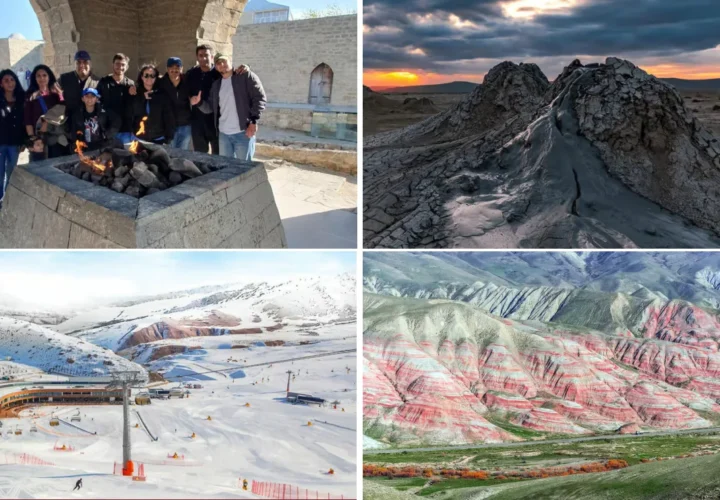
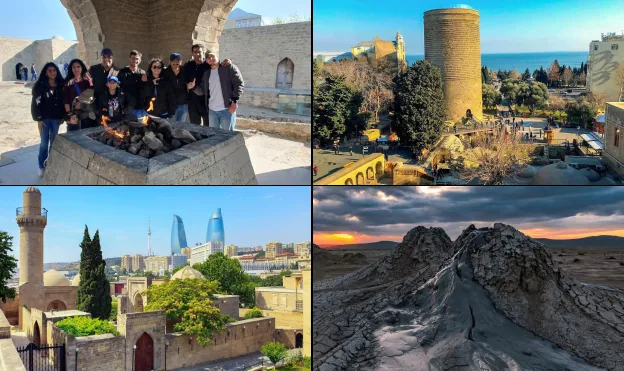
The central feature is a four-sided pavilion in the courtyard, traditionally associated with a ritual flame. Around it, a roughly pentagonal enclosure contains small rooms and cells. These spaces have been interpreted in relation to worship, accommodation and communal activity. The compact layout makes it possible to understand the site spatially without a long walk, but small details reward closer attention.
Look at doorways, stone construction and surviving inscriptions rather than concentrating only on the central flame. The inscriptions are especially important because they connect the complex to visitors from the Indian subcontinent and to traditions in which fire held religious significance. They also show that Ateshgah belonged to a network of mobility and exchange, not an isolated local cult.
Natural fire and historical change
The Absheron Peninsula contains natural hydrocarbon seeps, and flames produced by escaping gas contributed to the area’s unusual reputation. Over time, industrial extraction changed the local conditions. The visible fire at the modern heritage site should therefore be understood within a managed visitor setting rather than assumed to reproduce every historical natural feature exactly as earlier travellers experienced it.
This distinction does not reduce Ateshgah’s importance. On the contrary, it helps visitors appreciate why the site matters: geology created the conditions, trade routes brought people, and religious meaning developed through human interpretation. That layered explanation is more useful than treating the complex only as a visual curiosity.
Visiting with the right context
A focused visit can be completed in about one to two hours, depending on how much time you spend with interpretation and exhibits. The courtyard is exposed, so sun and wind can influence comfort. Spring and autumn are generally convenient for combining the temple with other outdoor stops on the peninsula.
Photography is straightforward in the open courtyard, but wide compositions that include the enclosure often explain the site better than close images of flame alone. Inside the cells, give priority to historical displays and architectural context. Avoid assuming every reconstructed object is original to the earliest period; heritage presentation often combines authentic fabric with interpretive material.
Pairing Ateshgah with nearby Explorer sites
Yanar Dag is the strongest companion site because it demonstrates a natural gas flame in the landscape rather than a constructed religious complex. The Absheron Peninsula Explorer entry provides the wider regional background, while Baku adds museums, architecture and the urban history of Azerbaijan’s oil era. Together, these places show several different ways hydrocarbons have influenced belief, economy and identity.
Ateshgah can also be visited before travelling to Gobustan, but the two should not be treated as variations of the same story. Gobustan centers on prehistoric and later rock art within an archaeological landscape; Ateshgah belongs to a much more recent network of trade, travel and religious practice. Keeping their timelines distinct makes a multi-site day more coherent.
Explore with Alov Travel
Tours for this area
Continue from inspiration to a relevant Azerbaijan experience connected to this place.
Plan the next step
Turn this place into part of your Azerbaijan journey.
Browse relevant experiences or share your dates and priorities with our local team.