
Region
Absheron Peninsula
The Absheron Peninsula travel experience begins just beyond central Baku, where a dry Caspian landscape holds medieval towers, fire-related heritage, villages, industrial history, and long coastal horizons. This guide helps visitors understand the peninsula as a region rather than a single attraction and plan logical combinations of its main cultural sites.
Quick Facts
Plan at a glance
- Best Season
- April–June and September–October
- Recommended Duration
- 1 day
- Distance from Baku
- 30 km
About this place
Understanding the Absheron Peninsula
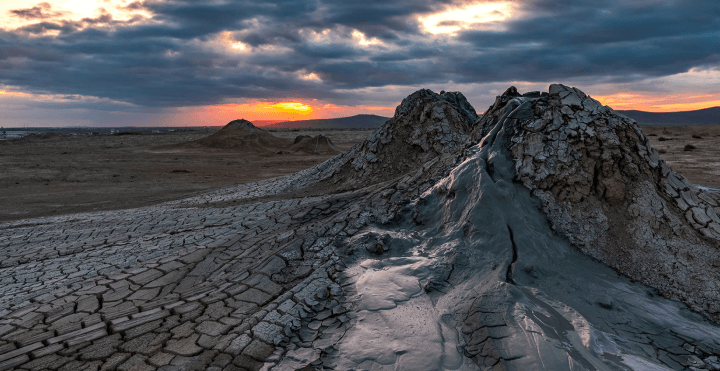
The Absheron Peninsula projects eastward into the Caspian Sea and includes Baku together with a ring of older settlements, industrial zones, coastal areas and protected heritage sites. Its appearance can surprise travellers expecting green countryside: much of the peninsula is dry and windswept, with pale earth, low vegetation and broad horizons. That landscape is part of its character and helps explain historic settlement patterns around wells, trade routes and defensible villages.
For visitors, Absheron is easiest to understand as a collection of related places. Ateshgah and Yanar Dag interpret different aspects of the region’s natural-gas and fire associations, while medieval towers and village fortifications point to a longer history of local defense. The Caspian coast adds another layer, showing how fishing, transport, industry and recreation have all shaped the peninsula.
Fire heritage: Ateshgah and Yanar Dag
Ateshgah Fire Temple stands in Surakhani, historically an area where natural gas could emerge close to the surface. The present complex developed through the early modern period and became associated with travellers and religious communities who treated fire as spiritually significant. Its enclosed courtyard, cells and central altar-like structure make it an architectural site as much as a story about natural flames.
Yanar Dag presents the geological side more directly. Here, natural gas escaping through porous ground sustains flames along a hillside. Visiting both places provides useful contrast: Ateshgah is a built heritage complex shaped by people, trade and belief, while Yanar Dag demonstrates a natural phenomenon that helped give the wider region its long-standing association with fire.
Medieval towers and village landscapes
Several Absheron settlements preserve medieval defensive architecture. Towers and castles at places such as Mardakan and Ramana reflect a period when local communities needed fortified positions overlooking approaches across the open terrain. Their forms vary, but thick stone walls and elevated vantage points recur across the peninsula.
These sites are particularly interesting when viewed in relation to the landscape. The peninsula’s relatively flat ground means even modest elevations provide long sightlines. Old village cores, mosques, bathhouses and stone walls can add context around the better-known towers. A route that includes one or two carefully chosen fortifications is usually more coherent than trying to collect every surviving monument in one day.
The Caspian edge of Absheron
The sea is never far away on the peninsula, yet the coastline changes significantly from place to place. Some stretches are urban or industrial, others are lined with settlements and seasonal recreation areas, and quieter sections retain a more open coastal feel. The Caspian is an inland body of water rather than an ocean, but its scale strongly influences Baku’s climate, wind and visual identity.
Travellers planning coastal stops should keep their expectations flexible. Shore access, local facilities and beach conditions can vary, while the cultural value of an Absheron day trip does not depend on swimming. In cooler seasons, the coast is still worthwhile for landscape photography and for understanding how closely the region’s history is tied to the sea.
When to visit
Spring and autumn suit most visitors because walking conditions are generally milder. Summer can be hot and exposed away from the coast, while winter winds can make short outdoor stops feel colder than the temperature suggests. The peninsula has little natural shade in many areas, so water, sun protection and a light wind layer are practical additions.
A full day allows time for a balanced route without treating the peninsula as a chain of brief stops. A common structure is to combine Ateshgah, Yanar Dag and one additional heritage or coastal area. Visitors staying longer in Baku can divide these places across separate half-days and explore them with less driving.
How Absheron fits into a wider trip
Absheron pairs naturally with Baku because the city occupies the peninsula’s western side and provides the historical museums and urban context that explain later regional development. Gobustan, in contrast, lies southwest of Baku and belongs to a different cultural and geological landscape, even though day itineraries sometimes group the areas together.
Within the Phase 1 Explorer network, use Absheron as the link between Baku’s urban story and the fire-related sites of Ateshgah and Yanar Dag. Travellers continuing into the mountains will find a dramatic change in scenery around Guba, Khinalig and Shahdag, making the dry Caspian peninsula a useful counterpoint to the greener and higher Greater Caucasus.
Landscape details worth noticing
Beyond the named monuments, Absheron rewards attention to materials and settlement form. Pale local stone appears in walls, courtyards and older houses, while wells and enclosed compounds hint at the practical challenges of living in a dry environment. In less built-up areas, low scrub and exposed earth make the peninsula feel visually open, with wind and light changing the atmosphere quickly.
This broader observation helps connect the peninsula’s heritage sites. Defensive towers make sense in an open landscape with long sightlines, fire-related sites belong to a hydrocarbon-rich geology, and coastal settlements reflect dependence on the Caspian. Seeing these elements together gives the region more coherence than treating each stop as an isolated attraction.
Explore with Alov Travel
Tours for this area
Continue from inspiration to a relevant Azerbaijan experience connected to this place.
 Explore
Gobustan & Absheron Tour from Baku: Mud Volcanoes, Fire Temple & Yanar Dag
Why Choose This Gobustan & Absheron Day Tour? More than just a trip to Azerbaijan, this thoughtfully crafted…
Plan the next step
Turn this place into part of your Azerbaijan journey.
Browse relevant experiences or share your dates and priorities with our local team.